Economic & Housing Market Update
Week Ending September 5, 2026
The first week of September brought renewed volatility to financial markets as investors balanced a surprisingly strong U.S. jobs report against persistent inflation concerns, rising Treasury yields, elevated oil prices, and continuing geopolitical uncertainty. For Southern California real estate, the message remains clear: buyers are still active, but affordability and mortgage rates continue to dictate purchasing power, while sellers are having to be increasingly realistic about pricing.
Stock Market & Dow Jones
Wall Street experienced a turbulent shortened trading week. Stocks began September under pressure as Treasury yields and oil prices climbed, but markets rebounded sharply Thursday after Federal Reserve Governor Christopher Waller suggested the Fed could remain patient if inflation continues to moderate. The Dow gained 1.18% on Thursday, while the S&P 500 rose 1.06% and the Nasdaq climbed 1.40%.
That enthusiasm faded Friday following the stronger-than-expected employment report. The Dow Jones Industrial Average fell approximately 0.51% Friday, the S&P 500 declined 0.38%, and the Nasdaq slipped 0.29% as investors increased their expectations that the Federal Reserve could raise interest rates again. Despite the volatility, the S&P 500 managed to finish the week with a small gain and remains close to its recent record levels.
The takeaway for housing is important: rising Treasury yields tend to put upward pressure on mortgage rates. The 10-year Treasury yield approached 4.8% Friday, making the bond market almost as important as the Federal Reserve itself when determining where mortgage rates go next.
Job Market Surprises to the Upside
The August employment report was considerably stronger than economists anticipated.
The U.S. economy added 162,000 jobs in August, while the unemployment rate remained unchanged at 4.1%. Average hourly earnings increased 0.3% for the month and 3.1% from one year ago. June and July employment figures were also revised upward by a combined 55,000 jobs.
Growth was particularly strong in food services, local government education and manufacturing, while the information sector lost jobs. The report suggests the economy remains more resilient than many economists expected.
For real estate, a healthy labor market is generally positive because employment supports household formation, consumer confidence and borrowers' ability to qualify for mortgages. The downside is that strong employment gives the Federal Reserve less urgency to lower interest rates—and potentially more reason to keep monetary policy restrictive.
Inflation Remains the Critical Issue
The most recently reported Consumer Price Index showed headline inflation running at 3.4% year-over-year in July, while core inflation, excluding food and energy, stood at 2.5%. The August CPI report is scheduled for September 11, making it one of the most important economic reports for mortgage rates this month.
Inflation remains above the Federal Reserve's 2% target, and markets are especially concerned about renewed energy inflation caused by rising oil prices and geopolitical instability.
Following Friday's jobs report, investors substantially increased expectations of another Federal Reserve rate hike at the September 15–16 meeting. Much will now depend on the upcoming CPI and Producer Price Index reports.
Mortgage Rates Move Higher
Mortgage rates edged higher again this week.
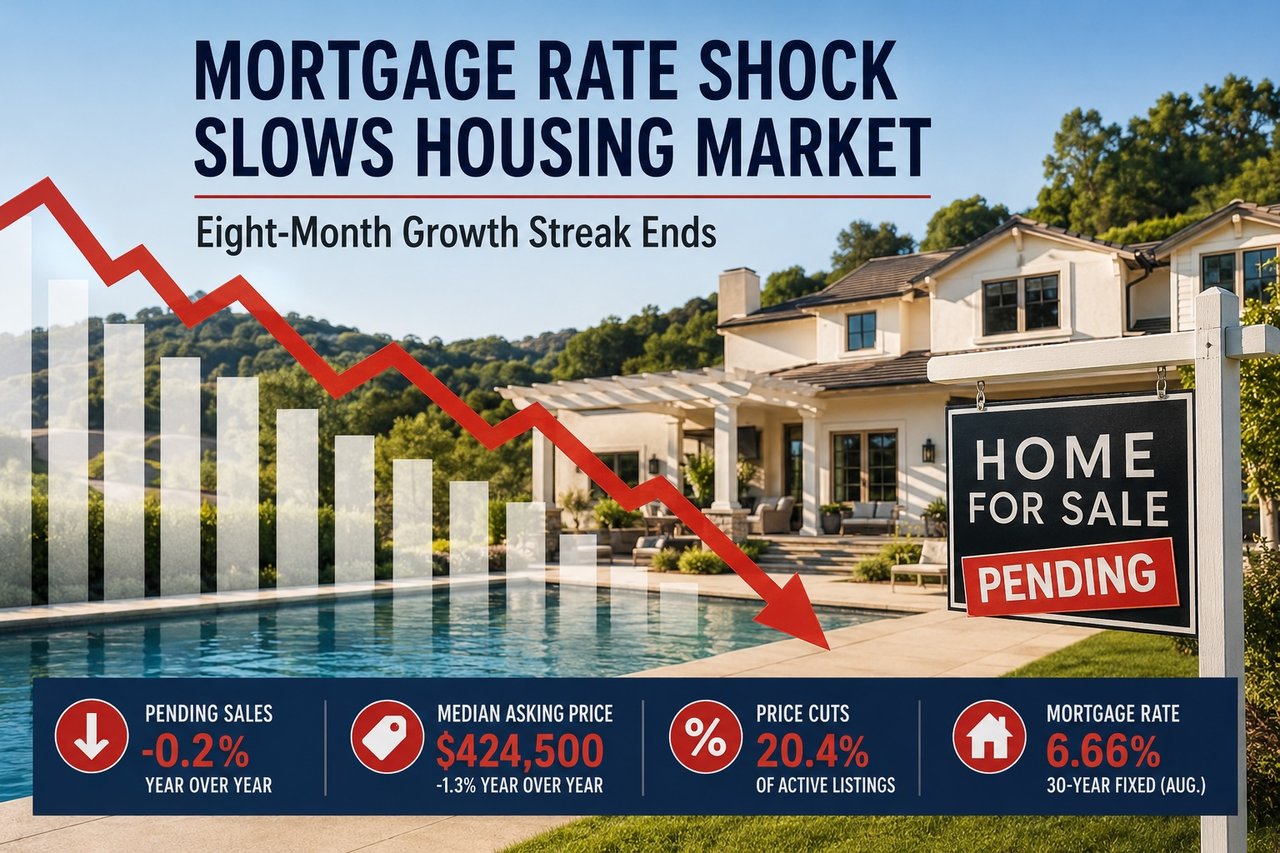
According to Freddie Mac, the average 30-year fixed mortgage rate reached 6.71% as of September 3, compared with 6.66% the previous week and 6.50% one year ago.
The average 15-year fixed mortgage reached 6.04%, up from 5.98% the previous week.
Some daily lender surveys were already showing rates closer to 6.8%–7% by Friday, reflecting the sharp increase in Treasury yields following the employment report.
Mortgage Rate Forecast
Earlier this summer, Realtor.com's midyear forecast projected the 30-year mortgage rate would average approximately 6.3% during 2026 and finish the year near 6.3%.
However, the environment has changed noticeably since that forecast. Stronger employment, higher Treasury yields, rising oil prices and renewed geopolitical uncertainty have increased the possibility that mortgage rates remain in the mid-to-upper 6% range for longer than originally anticipated.
A meaningful move back toward 6% will likely require convincing evidence that inflation is cooling and that the Federal Reserve can begin moving toward easier monetary policy. Conversely, another inflation surge or additional escalation in energy prices could push mortgage rates toward or above 7%.
For buyers, waiting exclusively for dramatically lower mortgage rates carries a risk: if rates eventually fall, pent-up demand could quickly return and increase competition for desirable homes.
Westlake Village Housing Market
Westlake Village continues to demonstrate why local real estate must be evaluated neighborhood by neighborhood rather than through national headlines.
Redfin's latest available data shows a median sale price of approximately $1.63 million for the City of Westlake Village over the three months ending July, approximately 16.1% higher than one year earlier. Homes averaged approximately 37 days on market, while closed sales declined considerably from the prior year.
Other Westlake Village-area data—which includes portions within Thousand Oaks—shows a median closer to $1.32 million, illustrating the considerable difference that neighborhood boundaries and property mix can make in this market.
Luxury buyers continue to be highly selective. Updated, appropriately priced properties in desirable neighborhoods can still receive significant attention, while overpriced or condition-challenged homes may remain on the market substantially longer.
For sellers, presentation, marketing and accurate pricing are increasingly important. Buyers at the higher end of the market are scrutinizing value rather than simply chasing inventory.
Thousand Oaks Housing Market
Thousand Oaks is showing a somewhat different pattern.
The latest Redfin data puts the median sale price at approximately $1.10 million, down about 5% year-over-year. Approximately 381 homes sold, a 16.1% increase from the previous year, while properties were taking roughly 42 days to sell.
That combination—more transactions but softer median pricing—suggests buyers remain willing to purchase when homes are appropriately positioned.
For buyers, this can create opportunities to negotiate price, credits, repairs or mortgage-rate buydowns, particularly when a home has accumulated significant days on market.
For sellers, today's market strongly rewards realistic pricing from the beginning. Overpricing a property and repeatedly reducing it later can create unnecessary market resistance.
Los Angeles Housing Market
Los Angeles remains expensive, but buyers are gaining somewhat more negotiating leverage.
Redfin reports a Los Angeles median sale price of approximately $1.06 million, down 1.4% from one year ago, with homes selling in approximately 50 days. Closed sales increased roughly 4.8% year-over-year.
More recent August listing data from Realtor.com shows the Los Angeles median list price around $1.05 million, down approximately 4.5% year-over-year, while roughly one in six listings had experienced a price reduction. Homes were taking approximately 53 days to sell.
Despite declining prices, inventory remains relatively tight. Active Los Angeles-area listings slipped slightly year-over-year while inventory nationally increased, preventing the market from shifting decisively into buyer-market territory.
This is increasingly a property-specific market rather than a universal seller's or buyer's market. Well-priced homes in desirable neighborhoods can still attract multiple buyers, while overpriced properties may sit and eventually require reductions.
How World Events Are Affecting Real Estate
Global events are once again influencing American mortgage rates through energy prices, inflation and the bond market.
Renewed military conflict involving the United States and Iran helped push oil prices sharply higher during the week. Brent and West Texas Intermediate crude moved into the $90-per-barrel range as markets worried about potential disruptions to Middle Eastern oil supplies and shipping.
Higher energy costs can filter into transportation, manufacturing, food and consumer prices. If that produces renewed inflation, the Federal Reserve may be forced to maintain higher rates for longer—or raise them further.
Global bond markets are also experiencing upward pressure on yields because of government borrowing, inflation concerns and changing central-bank expectations. Higher global bond yields can ultimately make mortgages and other forms of consumer credit more expensive.
For Southern California housing, geopolitical developments therefore matter much more than they might appear. An event thousands of miles away can move oil prices, inflation expectations, Treasury yields and ultimately the monthly payment on a home in Westlake Village, Thousand Oaks or Los Angeles.
What This Means for Home Buyers
Buyers should recognize that today's market may offer something that was difficult to find during the extremely competitive markets of previous years: negotiating leverage.
Higher mortgage rates have reduced competition in many price ranges. Depending on the property, buyers may be able to negotiate seller credits, closing costs, repairs, mortgage-rate buydowns or a lower purchase price.
Rather than trying to perfectly predict the bottom in mortgage rates, buyers should focus on purchasing the right property at a financially comfortable payment. A mortgage can potentially be refinanced later if rates decline; the purchase price of the home cannot be renegotiated after closing.
What This Means for Home Sellers
Sellers still have an important advantage in Southern California: quality inventory remains limited in many highly desirable neighborhoods.
But today's buyers are extremely educated. They follow comparable sales, price reductions, days on market and mortgage rates closely.
Properties that are properly priced, professionally prepared and aggressively marketed can still perform very well. Properties priced according to yesterday's market rather than today's market risk accumulating days on market and ultimately selling for less.
For luxury properties in particular, reaching the correct buyer locally, nationally and internationally is increasingly important.
Looking Ahead
The next two weeks could be critical for mortgage rates and housing.
Investors will be watching the August inflation report on September 11 followed by the Federal Reserve's September 15–16 meeting. Those events could determine whether mortgage rates move back toward the low-to-mid 6% range or test the 7% level again.
The Southern California housing market remains active, but it has clearly become more strategic. Buyers need strong negotiating representation, while sellers need accurate pricing, exceptional marketing and maximum exposure.
Thinking About Buying or Selling?
Real estate is hyperlocal, and national headlines rarely tell you what your individual home or neighborhood is actually doing.
If you are considering buying, selling or investing in Westlake Village, Thousand Oaks, the Conejo Valley or Greater Los Angeles, I would be happy to prepare a personalized market analysis and discuss how today's mortgage rates, inventory and economic conditions affect your specific situation.
Contact Tina Lucarelli for a confidential real estate consultation and customized property analysis. Whether you are buying your next home, selling a luxury property, relocating or evaluating your home's current value, having the right strategy can make a significant difference in today's changing market. (310) 738-8089