Mortgage Rate Shock Slows Housing Market as Eight-Month Growth Streak Ends
The housing market hit a speed bump in August as persistently high mortgage rates finally began taking a measurable toll on buyer demand.
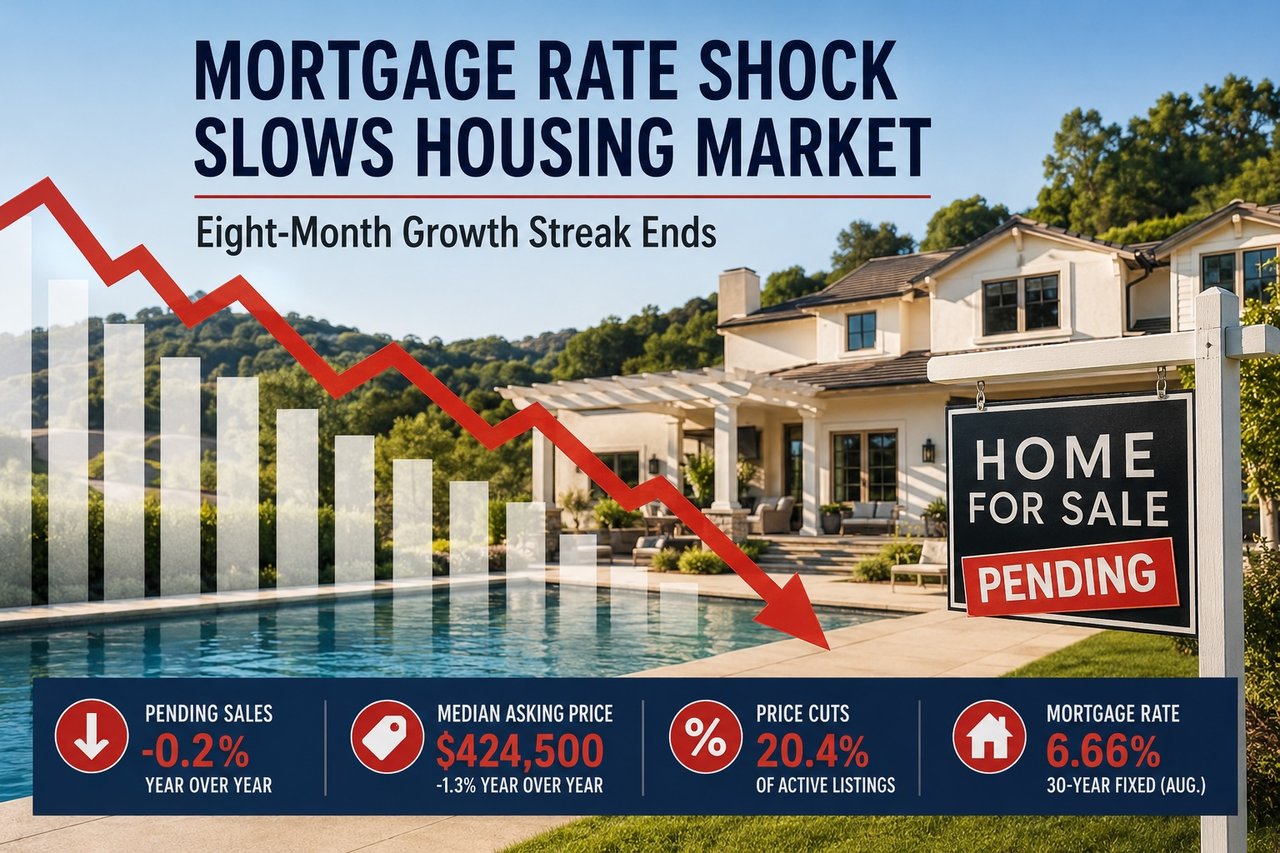
After eight consecutive months of year-over-year growth, the share of homes in pending status declined 0.2% compared with August 2025, according to Realtor.com’s latest housing market data. The shift suggests that higher borrowing costs, affordability pressures, and normal late-summer seasonality are causing more buyers to hesitate.
Mortgage Rates Are Testing Buyer Affordability
Mortgage rates have remained one of the biggest obstacles facing today’s homebuyers. The average 30-year fixed mortgage rate reached a 2026 high of 6.69% in early August and ended the month around 6.66%.
While buyers have largely accepted that the ultra-low 3% mortgage rates of the pandemic era are unlikely to return anytime soon, affordability remains challenging when higher interest rates are combined with home prices, property taxes, insurance, and other ownership expenses.
Even relatively small changes in mortgage rates can significantly affect a buyer’s monthly payment and purchasing power.
That means many buyers aren't necessarily leaving the market—they may simply be waiting for greater stability before making a move.
The West Is Feeling the Slowdown
The slowdown has not been evenly distributed across the country.
Pending sales declined approximately 4.3% year over year in the Midwest and 3.3% in the West. Meanwhile, pending sales increased 1.8% in the South and 1.1% in the Northeast.
For California buyers and sellers, the weakness in the West is particularly important. Higher home prices mean that changes in mortgage rates can have an even greater impact on monthly payments.
This can create a more price-sensitive buyer pool and put additional pressure on sellers to position their homes correctly from the beginning.
More Sellers Are Reducing Prices
Another important signal is the growing number of price reductions.
Approximately 20.4% of active listings nationally received a price cut in August. In the West, that figure reached roughly 22%.
The national median asking price also declined to approximately $424,500, down 1.3% from a year earlier.
However, this doesn't necessarily mean we're heading toward a housing crash.
Instead, the market appears to be moving toward greater balance. Buyers have more choices, homes may remain available longer, and sellers are increasingly competing for a smaller pool of qualified purchasers.
Buyers May Have More Negotiating Power
For buyers who are financially prepared, today's slower market could actually create opportunities.
Less competition can mean more time to evaluate a property, greater negotiating leverage and potentially more flexibility on price, repairs, closing costs, rate buydowns or other seller concessions.
Trying to perfectly time mortgage rates can also be risky. If rates decline substantially, affordability could improve—but lower rates could simultaneously bring more buyers back into the market and increase competition.
The better question may be: Does the home make sense for you at today's price and payment?
If it does, there may be opportunities to negotiate now and potentially refinance later if rates eventually decline.
Sellers Need the Right Pricing Strategy
For sellers, this is becoming a market where accurate pricing matters more than ever.
The days of simply placing a home on the market at an aspirational price and expecting buyers to compete for it are increasingly limited.
Today's buyers have access to more inventory, more information and more negotiating leverage. Homes that are properly priced, professionally marketed and presented well can still attract serious buyers, while overpriced properties risk sitting on the market and requiring subsequent reductions.
In luxury markets such as Westlake Village, Thousand Oaks, Lake Sherwood, North Ranch, Calabasas and the greater Los Angeles area, understanding local competition is especially important because national housing statistics don't always reflect what is happening within an individual neighborhood or price range.
What Could Change the Fall Housing Market?
Mortgage rates will likely remain one of the most important factors to watch this fall.
A meaningful decline could improve purchasing power and encourage buyers who have been waiting on the sidelines to return. Lower rates could also help homeowners who currently feel "locked in" by their existing low mortgage rates become more comfortable selling and purchasing another property.
But stability may be nearly as important as lower rates.
When rates fluctuate dramatically from week to week, buyers have difficulty knowing what they can comfortably afford. A more predictable mortgage environment could restore confidence even if rates remain above historical lows.
The housing market isn't frozen—it is adjusting.
And changing markets often create opportunities for buyers and sellers who understand how to position themselves strategically.
Thinking About Buying or Selling?
If you're considering buying, selling or investing in Westlake Village, Thousand Oaks, Lake Sherwood, North Ranch, Calabasas, Malibu or the greater Los Angeles area, now is the time to understand what these changing market conditions mean for your specific property, neighborhood and price range.
Whether you want to know what your home could realistically sell for, how much negotiating power you may have as a buyer, or whether it makes sense to move now versus waiting for mortgage rates to change, I would be happy to help you develop a strategy.
Contact Tina Lucarelli, Global Real Estate Advisor, for a confidential real estate consultation and personalized market analysis.
Thinking of selling? Let's determine what your home is worth in today's market.
Thinking of buying? Let's identify where today's slower market may give you an advantage.
The right opportunity doesn't always appear when the market is perfect—it often appears when you know how to navigate the market you're in.